

Ngaroma Riley: tekoteko in contrapposto
An essay by Giulia Pianelli—commissioned by Season Aotearoa and artist Ngaroma Riley.Tekoteko in Contrapposto is a new commission by artist and curator Ngaroma Riley (Te Rarawa, Te Aupōuri) presented with Season Aotearoa at the Aotearoa Art Fair 2025. Comprising three sculptures, this body of work explores the technique of contrapposto and its application to traditional Māori sculpture, incorporating emblematic references to whakapapa and Indigenous knowledge.
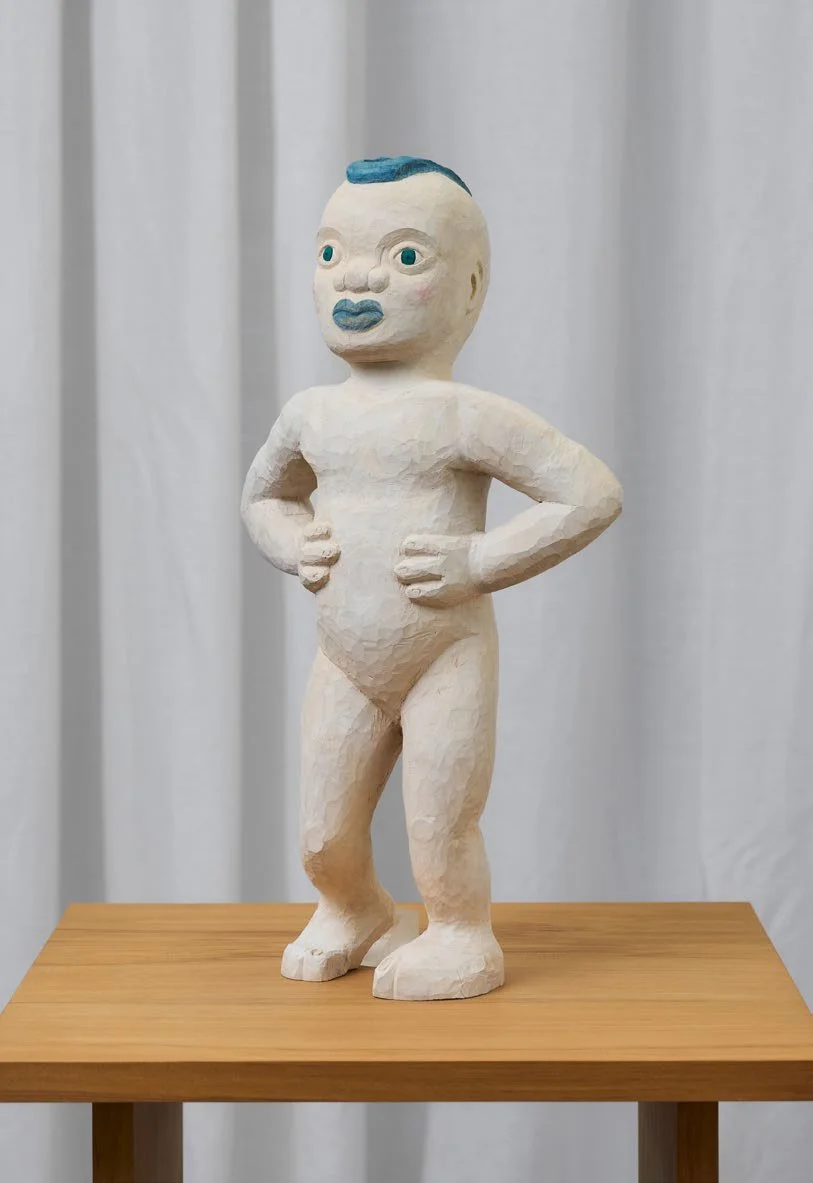
Ngaroma Riley, Tūrehu Arms Akimbo, 2025. Courtesy of Season Aotearoa.
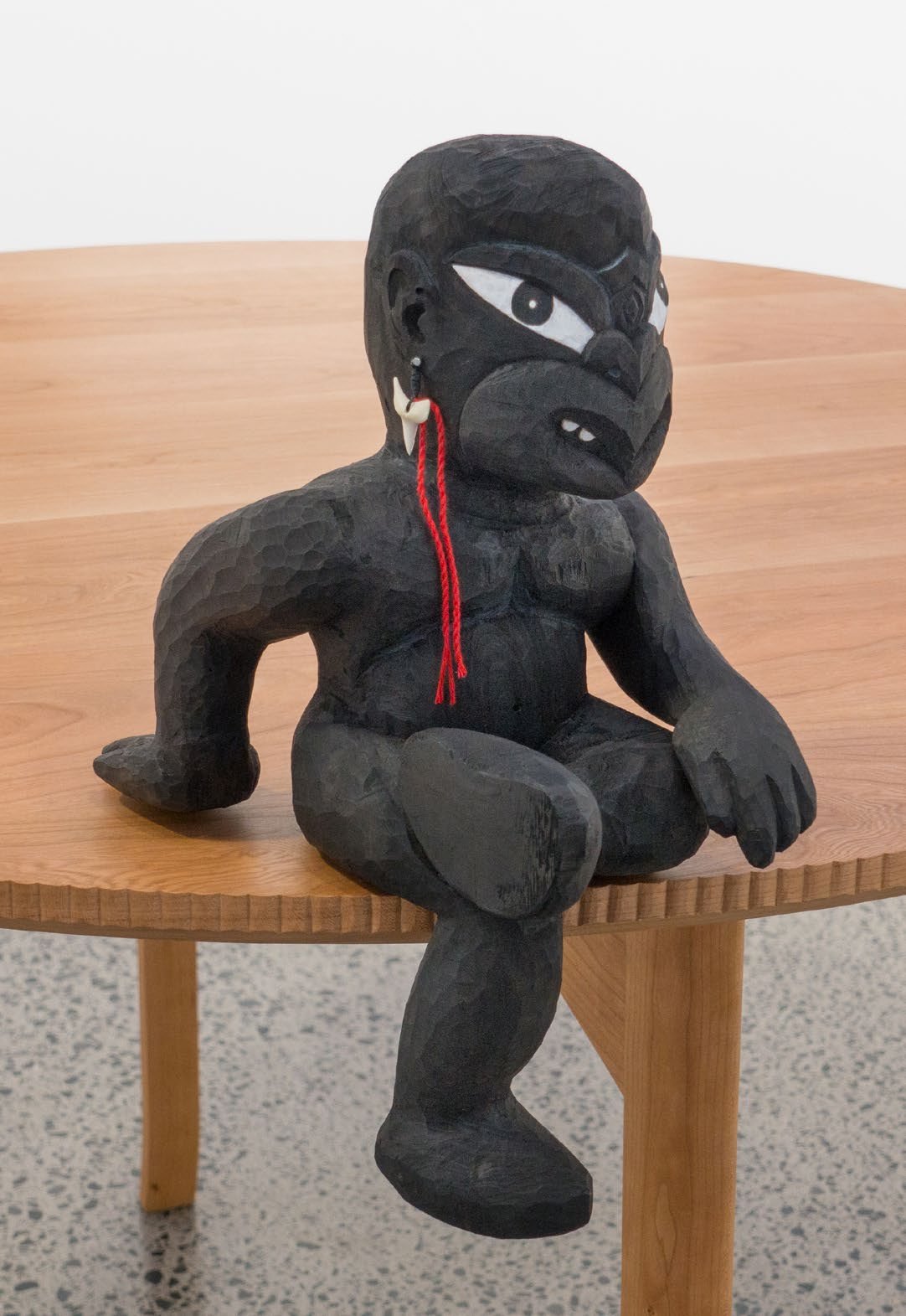
Ngaroma Riley, Tekoteko in Half Lotus, 2025. Courtesy of Season Aotearoa.
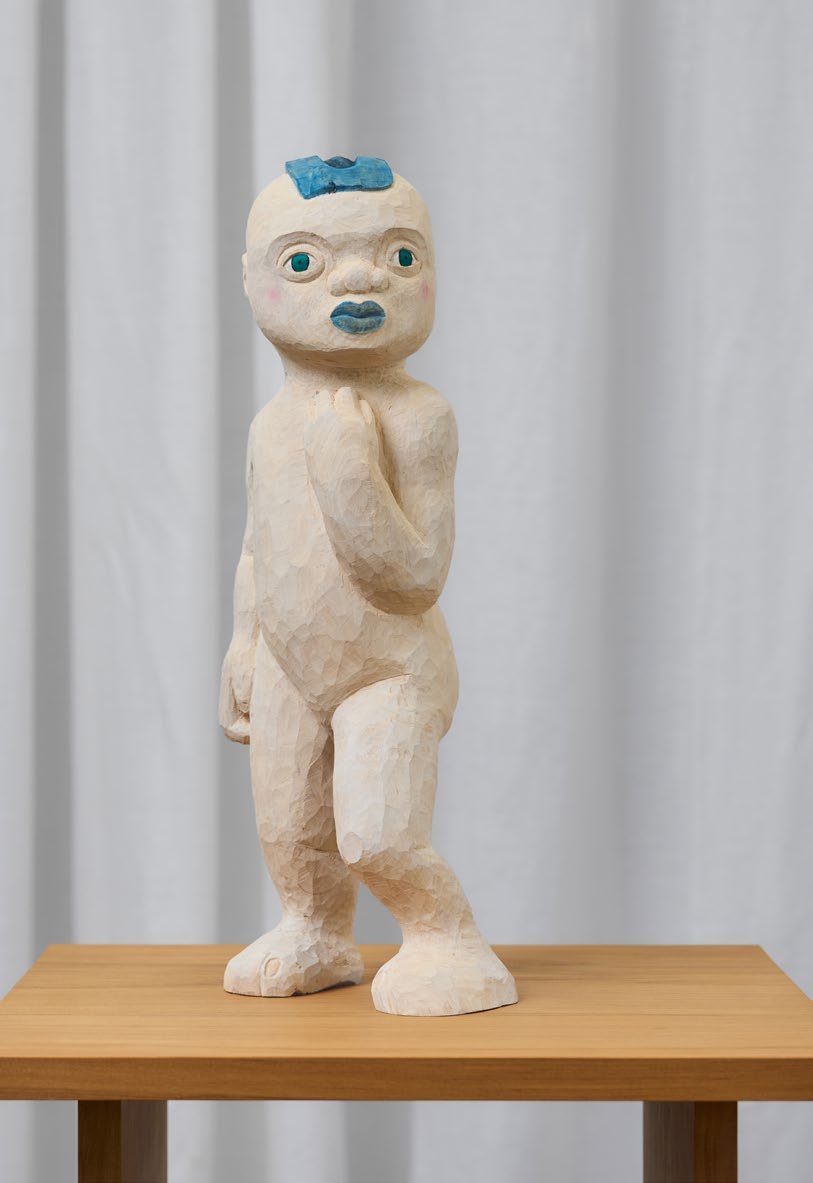
Ngaroma Riley, Tūrehu after David, 2025. Courtesy of Season Aotearoa.
Translating from Italian as “counterpoise” or “opposite”, contrapposto is a sculptural technique used to depict the human figure in a natural pose where one part of the body twists or turns away from another, and most of the weight concentrated on one leg. While its origins can be traced back to ancient Greece (5th century BCE), the technique became a cornerstone of Western art history during the Italian Renaissance (1400–1500 CE). Renewed interest in the technique quickly spread across Europe and into other media, including painting, and—more recently—photography and video art.
Although it gained worldwide popularity through Renaissance sculptures like Michelangelo’s David, the contrapposto stance also appears widely in East Asian art, likely due to Alexander The Great’s military expansion into the Indian subcontinent in the 4th century BCE. Riley’s first approach to sculpture came through the Japanese Buddhist figurative tradition. In her early carving practice, she studied how to sculpt bodhisattva—individuals who have resolved to become Buddhas—as a gateway into figurative sculpture. Both bodhisattva and kongōrikishi—the muscular guardians of the Buddha—are often depicted in contrapposto, indicating the spread of the technique across continents.
Drawing on her experience in Japanese figurative sculpture and her knowledge of toi whakairo, Riley applies contrapposto to traditional Māori sculpture. Tekoteko in Contrapposto reflects a fusion of different techniques and styles, as well as the artist’s ongoing exploration of figurative sculpture. Riley says: “I'm particularly drawn to the naturalistic stance of contrapposto, which feels much softer compared to the rigid posture of the tekoteko. I'd like to experiment with different poses by studying the figurative forms used in European art, while pushing the boundaries of what is typically defined as Māori carving.”
Tekoteko in Contrapposto comprises three works: two standing Tūrehu (Tūrehu after David, 2025, and Tūrehu Arms Akimbo, 2025) and one seated Tekoteko (Tekoteko in Half Lotus, 2025). The Tūrehu—white and eerie fairy folks—are a reference and a mihi to one of the artist’s tūpuna, who was supposedly a Tūrehu. Their blue hair and lips evoke the earthen pigment pukepoto, which is also the name of a small town in Northland where Riley’s local marae is located, and where her grandfather grew up. When carving Tūrehu, Riley uses the form and attributes of the Tekoteko as a starting point, layering in highly personal details. In addition to their more naturalistic style, Riley’s Tūrehu feature characteristics based on some of her family members, such as her cousin and children. In contrast to the Tūrehu’s colour, the Tekoteko is painted black with white eyes and a round head, reflecting the style of Te Tai Tokerau carvings. However, this Tekoteko bears no moko kanohi (facial tattoos), as all the sculptures in Tekoteko in Contrapposto are intentionally non-binary.
The choice of Tūrehu and Tekoteko as subjects is also significant. As previously mentioned, Riley is connected to Tūrehu through whakapapa. Although these fairy folks are common to many iwi across the motu, their origins remain uncertain, echoing other aspects of Māori knowledge lost or fragmented through colonisation. Hence the role of the Tūrehu in the artist’s work: beacons of resistance and rediscovered pūrakau. When describing her mahi, Riley states: “[my work] reflects on and celebrates pre-colonial Māori life. It recognises skills that have been threatened but still can be remembered and reclaimed.” The Tūrehu presented at the Aotearoa Art Fair are fittingly paired with the Tekoteko as the kaitiaki/kongōrikishi (guardian) of lost mātauranga. Similarly to Michelangelo’s contrapposto masterpiece David, who stands poised to confront the arrogant Goliath, Riley’s sculptures are also a testament to cultural reappropriation and Indigenous resistance in the face of colonial oppression.
By placing Māori carving in dialogue with Classical and East Asian sculptural traditions, Tekoteko in Contrapposto prompts a reconsideration of how Indigenous knowledge systems can be reactivated through contemporary practice. Riley’s work raises important questions about the role of cross-cultural influence in shaping the future of Māori art. Rather than offering definitive answers, Tekoteko in Contrapposto opens a space for critical inquiry, inviting reflection on the evolving relationship between tradition, innovation, and cultural sovereignty.
Read the full essay here.