

Lines We Carry
Curatorial essay accompanying the exhibition Lines We Carry, including work by Le Vu and Rebekah Sohn.
One of the fondest memories I have from curating Lines We Carry is of a simple conversation with the artists, Le Vu and Rebekah Sohn. We had just visited the New Zealand Steel Gallery at Franklin Arts Centre to begin planning our upcoming exhibition when we sat down for a coffee. What started as a brainstorming session about exhibition-making gradually turned into a much deeper conversation about the founding values of our home countries and about being raised according to those values.
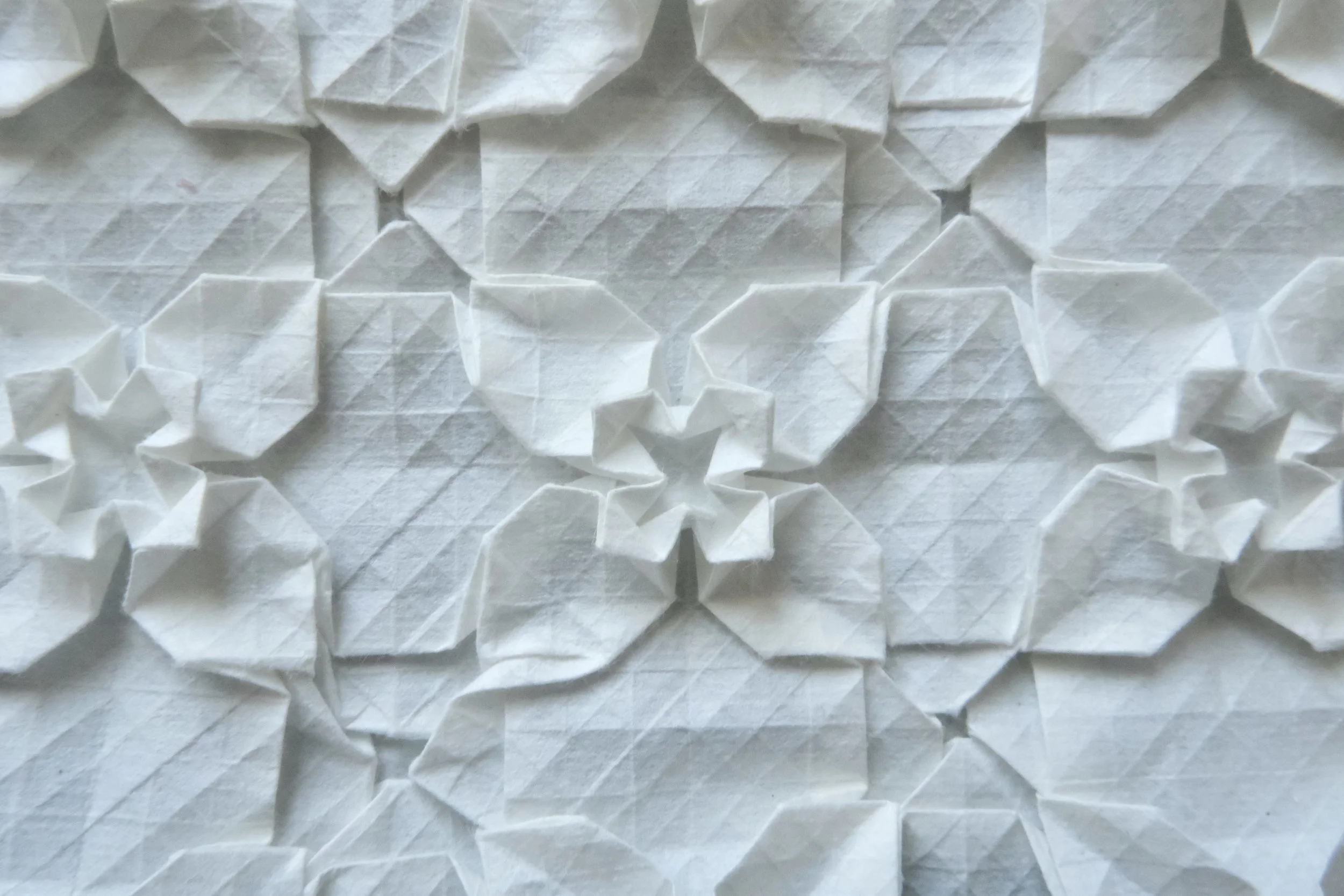
Rebekah Sohn, Hanji series 3, 2026 (detail). Courtesy of the artist.
Le was born and raised in Hanoi, Vietnam; Rebekah was born in Aotearoa to Korean parents; and I was born and raised in Venice, Italy. As expected, Rebekah and Le found many similarities in the ways they were raised by their families and in the cultural values shared by both Vietnamese and Korean communities. What came as a complete surprise, however, was how many of these same values also characterise Italian culture. Hearing Le and Rebekah’s stories unexpectedly reminded me of my own upbringing in a completely different context, thousands of kilometers away from South Korea or Vietnam.
Yet, our experiences intertwine on many fronts. I couldn’t help but notice an overlap not only in our education, but also in the ways we reclaim our cultural traditions as first- and second-generation migrants. According to Le, “Migration is a continuous, sacrificial commitment that reshapes one’s identity. [My work] is my way of reclaiming authority in the hands of the marginalized. It offers a space for invisible people to be seen, heard, and have their stories told.” Her handcrafted Low Dining Table (2024) responds to this statement as an intimate investigation into the Vietnamese diaspora in Aotearoa, bearing inscriptions from Cảnh Ngày Xuân, a famous 1813 poem by Vietnamese writer Nguyễn Du. This literary work holds significance in the collective memory of Vietnamese people, and carries personal weight within Le’s own family history, as her mother named both her and her sister after a verse from the poem.
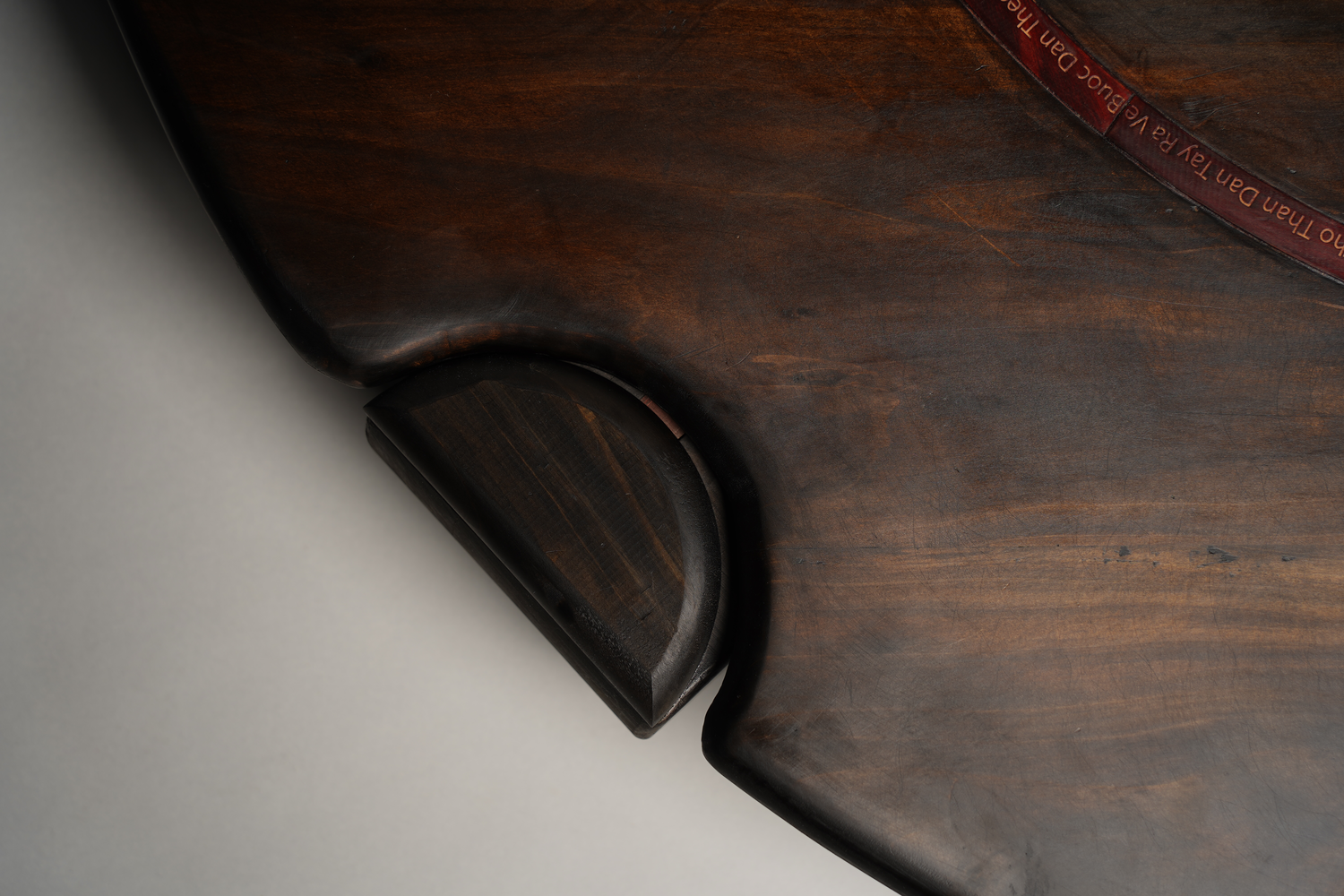
Le Vu, Low Dining Table, 2024 (detail). Courtesy of the artist.
Another common aspect of our upbringing, to my surprise, concerns the idea of “sacrifice”, which I had thought was tied specifically to Italy’s deep Catholic culture, but which I discovered is also widespread in many East Asian cultures. In contemporary life, this concept of sacrifice often translates into hard work or labour: repetitive tasks that require patience and frequently involve solitude. Repetition, patience, and time spent alone are central to Rebekah’s practice. Her work is grounded in calming, meditative processes involving repetitive, almost ritualistic actions. Her paintings (Morning hour, 2024; Nightfall, 2023; Wish you well, 2026) are informed by regular walks around her neighbourhood on Auckland’s North Shore, a practice she cherishes as a daily ritual. The black-and-white palette references the 1970s Korean Dansaekhwa (monochrome painting) movement (1). Also associated with Dansaekhwa is the use of hanji (mulberry paper), a material with which Rebekah has recently been experimenting in her jong-i-jop-gi (종이접기), or paper-folding work (Hanji series, 2026).
Paper folding and tessellation are highly labour-intensive practices that require the artist to spend long periods alone, patiently folding the paper again and again. This repetitive act reminds Rebekah of the time her parents spent at work. She describes the hundreds of folds in her jong-i-jop-gi work as “a form of memory, a mark of a gesture”. She notes, “Even when unfolded, the paper remembers.” While Dansaekhwa artists like Park Seo-Bo or Ha Chong-Hyun engaged in slow, repetitive processes as a means of healing from the trauma of the Korean War (2), Rebekah’s practice allows her to gently explore her own Korean heritage while retracing behavioural patterns she observed in her family while growing up. Similar ideas are reflected in Le’s work Rong (2023), a lamp through which she also explores nghệ thuật gấp giấy (paper-folding art) as a practice tied to her school years in Hanoi. In this work, however, paper is replaced by repurposed Kevlar extracted from New Zealand Police body armour, creating a contrast between the carefree innocence of her childhood in Vietnam and the challenges of her adult life in Aotearoa.
Although these ideas may be difficult to comprehend or relate to in many Western cultures, they are values the three of us carry within us, often without fully realising it. Especially when it comes to the broader meaning of “sacrifice” and endurance, which can be understood as care and, ultimately, as love. When we first spoke, Le taught me a Vietnamese word that does not have a direct translation in English: thương. She explores its meaning in her moving image work At Thresholds (2024), which accompanies her Low Dining Table. Thương refers to a form of love expressed not through words but through everyday gestures and acts of care, such as preparing food for loved ones. According to Le, the family dining table is where thương is most fully manifested. “Food is our love language,” she says. I’m certain that my late Italian nonna, despite speaking only Venetian dialect and very little Italian, would have immediately understood the meaning of thương, recognising the way love is not spoken, but demonstrated through small actions and, above all, through food.
All this shared cultural knowledge, and the conversations that emerged from it, is what Lines We Carry arose from. Le and Rebekah’s practices consider how we preserve, transform, and share this knowledge, with their works acting as methods of remembrance and tools for reimagining identity in a new context. An Italian proverb, often mistakenly attributed to Charles Darwin, states: “Il lavoro nobilita l’uomo”, which translates as “Work ennobles man” or, in a common variant, “Work makes the man”. I have always disagreed with this saying. I do not believe that work is what defines us. In my opinion, what makes a person, or rather what makes people, is culture: our attachments, our heritage, and the lines we carry with us so proudly and so emotionally. Lines We Carry is our home away from home, a space in which we lay bare our memories and traditions to celebrate diversity as richness rather than difference.
Giulia Pianelli
Sources
1) Kim, H. 2023. What You Don’t See: Meditating on Korean Monochrome Painting. Art Institute of Chicago. https://www.artic.edu/articles/1048/what-you-dont-see-meditating-on-korean-monochrome-painting.
2) Yau, J. 2022. Abstractions That Record the Scars of Trauma. Hyperallergic. Available at: https://hyperallergic.com/abstractions-that-record-the-scars-of-trauma/.