
Noa Hāmana: HAERENGA
Curatorial text accompanying the exhibition Haerenga by noa hāmana (Ngāpuhi, Ngāti Kura, Ngāti Toa).
There’s an Italian song I’ve been listening to lately that goes: “Se non ricordo chi eravamo, io non mi ricordo chi siamo” (1), which roughly translates to: “If I don’t remember who we were, I won’t remember who we are”. Every time I play it, I can’t help but think of noa hāmana’s art.
Haerenga (2026), his latest body of work, is a series of paintings drawing from historical events, Māori mythology and mātauranga, literature, and art history, as well as the artist’s own experience as tangata whenua growing up in Aotearoa and later finding himself retracing his ancestors’ cross-colonial pathways.
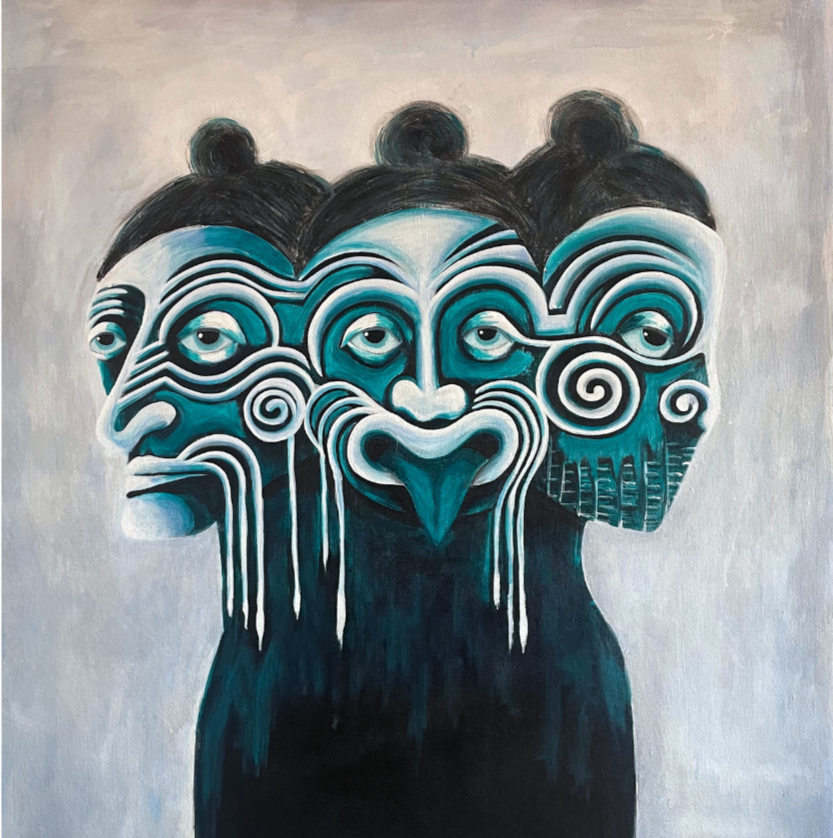
noa hāmana, Arctic Hysteria, 2025. Acrylic on canvas, 900 x 900mm. Courtesy of the artist.
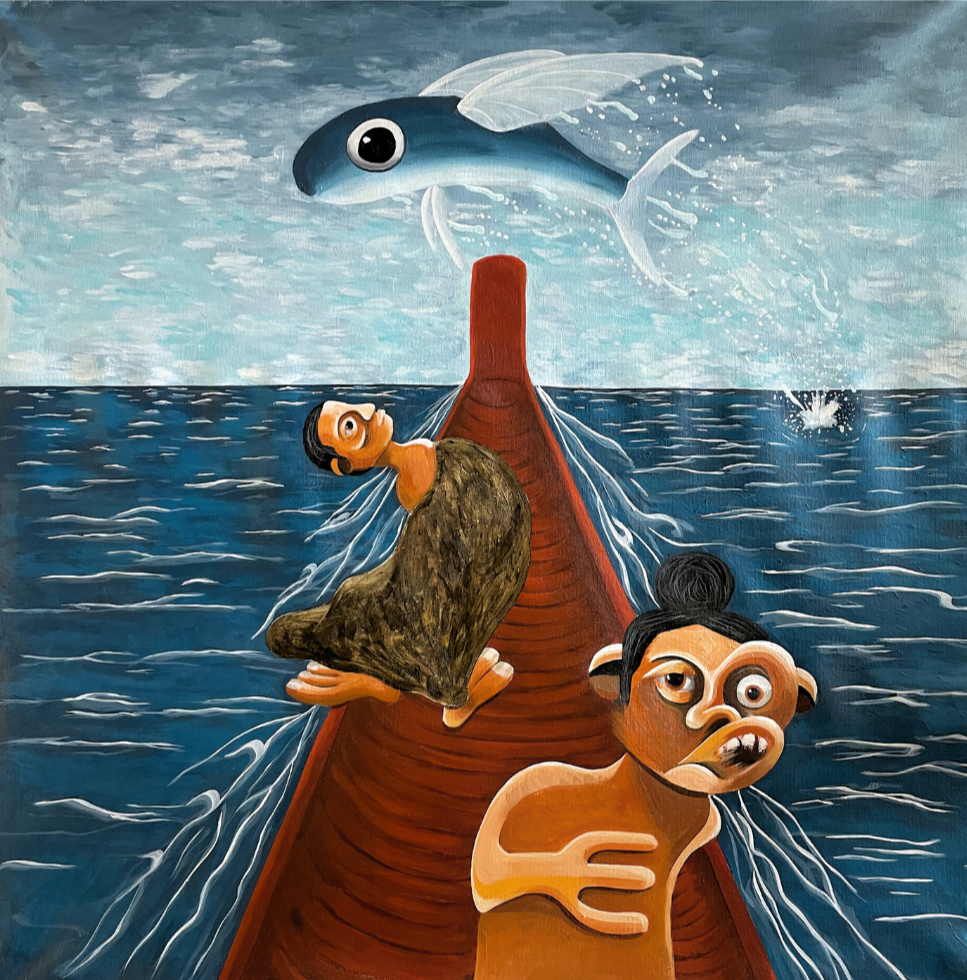
noa hāmana, Te Maroro Kokoti Ihu Waka Taua, 2026. Acrylic on canvas, 900 x 900mm. Courtesy of the artist.
noa’s paintings are born out of research. Rigorous, self-directed research. How else could it be in a country where colonial history and its ongoing consequences are still insufficiently addressed? An “Aotearoa New Zealand’s Histories” curriculum was only introduced in 2023 (2), Art History has recently been removed from many secondary schools across the motu, and students often leave school with only a limited understanding of Te Tiriti o Waitangi and its implications. Me tiro whakamuri, kia anga whakamua (walking backwards into the future) is what noa does when he paints.
After two bodies of work exploring Māori identity (Storms Began as Breezes, 2024) and the first encounters between Māori and Pākehā, particularly the earliest journeys rangatira made to Australia (Te Koha, 2025), noa’s focus in Haerenga shifts toward Māori migration. More than a shift, it feels like a natural continuation of his wider research. Through pūrākau and mātauranga, he examines migration as something that has long shaped movement across Moana-nui-a-Kiwa — from Kupe’s voyage on a waka hourua to today’s cross-colony movement between Aotearoa and Australia.
In 2024, a record-breaking 72,000 New Zealand citizens left the country long-term, with more than half relocating to Australia (3). The Māori diaspora there now exceeds 170,000 people, meaning roughly one in five Māori live across the Tasman (4). What drives so many people to leave? And what is left behind in the process? According to Stats NZ Tatauranga Aotearoa, recent migration trends are largely driven by a weak labour market and the rising cost of living. For noa, however, the issue runs deeper, tracing back to the way colonies were established as economic projects. In Haerenga, he steps back through history, reflecting on the systems and ideologies that have shaped the present: from early religious missions and the introduction of foreign crops, to the colonial fantasy of the “Noble Savage” and taonga now sitting in the storage rooms of European institutions such as the British Museum.
Not long ago, I was speaking with a dear friend, an established curator, about noa’s practice and upcoming exhibition. They asked a question that stayed with me: “Why does the content of his paintings feel so generalised? Why doesn’t he depict his own lived experience?” But he does, just on his own terms. After all, why speak only of yourself when your experience is shared by many? He waka eke noa — we are all in this together. Even his artist name reflects this ethos: noa (common / profane), hā (breath), mana (spiritual power, authority). Through painting and writing alike, noa reflects on experiences that extend beyond the personal and resonate collectively, drawing on whakapapa as a living continuum in which time collapses and the artist becomes a vessel for stories passed on across generations.
Yet, these paintings reveal more about him and the emotional weight he carries than anything he has explicitly written or said about himself. He once told me: “You can’t get away unless you leave something behind.” As a migrant myself, I could not agree more. There is anger in noa’s paintings, but also longing and hope. I see a disillusioned 13-year-old boy waking up in earthquake-torn Ōtautahi, riding his bike up Tauhinukorokio / Mount Pleasant and imagining the tangata whenua and iwi who once populated the area. I see a hopeful young man leaving for London, “the motherland”, only to return Down Under and eventually settle in the neighbouring colony across the Tasman. Through his paintings, noa speaks to the frustrations of his own generation — our generation — increasingly willing to “leave something behind” in search of a better future.
However, leaving something behind also means carrying something forward. And that “something” that travels with us is culture: a whakataukī, a recipe from your kuia, a karakia, a waiata, mātauranga, pūrākau. Once carried across Moana-nui-a-Kiwa by Kupe and the earliest voyagers centuries ago, these things are now packed into suitcases and carried toward the next destination. Even in displacement, if we remember who we were, we will remember who we are.
Giulia Pianelli
Sources
1) Blanco, Mina. 2023. Un Briciolo di Allegria, from: Innamorato. Italy: PDU Music&Productions.
2) Bolstad, R. et al. 2025. Teaching and learning about the histories of Aotearoa New Zealand: School leaders and kaiako experiences with early curriculum implementation. NZCER. https://doi.org/10.18296/rep.0067.
3) Stats NZ Tatauranga Aotearoa. 2025. Net migration loss to Australia in 2024. Available at: https://www.stats.govt.nz/news/net-migration-loss-to-australia-in-2024/.
4) Hassett, C. (no date). Broader Horizons: What it means to be Māori in Australia. Available at: https://www.tepapa.govt.nz/discover-collections/read-watch-play/maori/te-wiki-o-te-reo-maori-stories-wireless/broader-horizons.